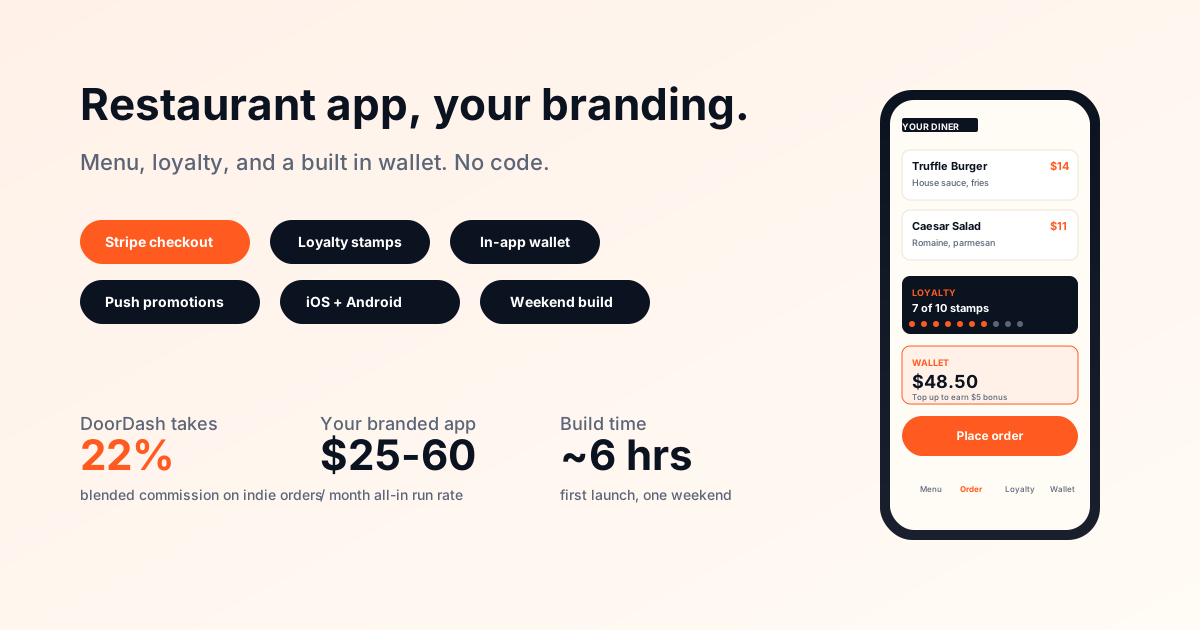
Restaurant App Cost vs DoorDash Commission: The 2026 Math for US Operators
A US restaurant doing $30,000/month through DoorDash hands over $4,500-$9,000 in commission every single month. Here is what your own branded ordering app actually costs, what it earns back, and how the math compares for independent operators.
DoorDash, Uber Eats, and Grubhub charge US restaurants 15-30% per order. A typical $30K/month operator gives the platforms $4,500-$9,000 monthly. A branded restaurant app costs $15-99/month plus standard payment processing (around 2.9% + 30 cents per order). For any restaurant doing more than $4K-5K/month through third-party apps, switching even half that volume to a direct app pays for itself in the first month.
Every US restaurant owner who has ever opened a DoorDash invoice has had the same thought: "There has to be a better way." DoorDash takes 15-30 percent of every order. Uber Eats and Grubhub are in the same range. For a restaurant doing $30,000 per month through third-party apps, the math is brutal: roughly $4,500 to $9,000 of revenue, gone, before any food cost or labor is paid.
The alternative everyone has heard about is "build your own app." The reason most operators do not act on it is the assumption it costs $50,000 and takes six months. In 2026, both of those assumptions are wrong.
Build your app with AI
No coding required
Turn your idea into a native iOS and Android app. Swiftspeed’s AI app builder makes it fast and easy.
Start BuildingThis post walks through the actual cost of a modern restaurant app, the actual savings versus marketplace commission, and where the break-even line sits for restaurants of different sizes.
What DoorDash, Uber Eats, and Grubhub actually charge in 2026
The headline rate hides a layered fee structure. As of 2026 in the US:
- DoorDash Basic: 15% commission + tablet/POS fee + payment processing
- DoorDash Plus: 25% commission, includes promotional placement
- DoorDash Premier: 30% commission, includes higher placement + Dasher priority
- Uber Eats: 15-30% depending on tier (Lite, Plus, Premium)
- Grubhub: 15-30% with marketing add-ons that push higher
Most independent restaurants end up on Plus or higher because the Basic tier produces almost no order volume due to lower listing placement. The effective blended rate for an independent on DoorDash is typically 22-28%.
The cost of your own restaurant app in 2026
A modern branded restaurant app has two cost components:
- Platform subscription. $15-99 per month for a no-code restaurant app builder like AppBuilder24. Includes hosting, push notifications, in-app commerce, analytics, and unlimited orders.
- Payment processing. Same as you pay for any card transaction: roughly 2.9% + 30 cents per order through Stripe or PayPal. This is the actual cost of accepting card payments, not a marketplace commission.
That is the whole bill. No per-order commission. No marketing fees. No tablet rental. No customer data sold to your competitors.
The math, side by side
That is a single restaurant. At the typical 22-28% effective DoorDash rate, the cost of your own app pays for itself within the first few days of any month at any reasonable order volume.
The break-even line
For a US restaurant deciding whether the math justifies a branded app, the question is: how much of my online order volume do I need to redirect from DoorDash to my own app to break even?
- If you do $5,000/month through DoorDash at 25%: switching 30% of that volume to your own app saves more than the $29/month subscription costs.
- If you do $15,000/month: switching just 10% of orders covers the platform cost. Switch half and you save $1,500/month net.
- If you do $50,000/month: every percentage point of volume you move to direct ordering is $500/month in your pocket. A single regular who switches saves you $30-50/month in commission for the year.
The threshold is low. Almost no US restaurant doing online orders today fails the break-even test.
The non-obvious wins beyond commission savings
The commission math is the obvious win. The bigger long-term wins are less visible:
You own the customer relationship. DoorDash will never give you the email address, phone number, order history, or contact info of the customers who order through them. They are DoorDash customers who happen to eat your food. Your own app captures the customer record on first order. You can reach them with push notifications, email, SMS, and birthday offers forever.
You control the menu and pricing in real time. Sold out of the special? Take it off the menu instantly. Running a flash promotion for Tuesday lunch? Push it out at 11am and watch the orders come in. None of that flexibility exists on a marketplace listing.
Repeat-order rates climb. Industry data shows app-installed customers reorder 2-3x more often than web-only or marketplace customers. The home-screen icon, push notifications, and one-tap reorder flow all work together to keep your brand top of mind.
Loyalty programs that actually work. A built-in loyalty program (buy 9, get 10th free, or points per dollar) drives 15-25% more repeat visits in published industry data. DoorDash does not offer that on your behalf. Your own app does it by default.
What an app can do that DoorDash cannot
Beyond the cost equation, there are entire categories of features that simply do not exist on the marketplaces:
- Catering and large orders. Take advance orders for office lunches with custom menus, delivery scheduling, and per-head pricing.
- Subscription meal plans. Weekly recurring orders for regular customers. The marketplaces have no subscription primitive.
- Skip-the-line pickup. Power-user customers can order in the app and skip the line. Drives loyalty among your most valuable regulars.
- Gift cards. Sell digital gift cards directly. Marketplaces do not support this for individual restaurants.
- Table reservations alongside ordering. One app for both the dine-in and the takeout experience.
Do you keep DoorDash or drop it?
Most successful US operators run both. The honest reason is acquisition: DoorDash and Uber Eats are still where new customers discover restaurants for the first time. You pay the 25% on those acquisition orders as the cost of new-customer marketing.
But for your existing regulars, you push them to install your own app. Use loyalty rewards as the carrot. Hand out QR codes at the register. Put the App Store and Google Play badges on every takeout bag and receipt. Over 6-12 months, the mix shifts: more direct app orders, less marketplace orders, higher margins, better customer data.
How to actually build this
The path most US independents take in 2026:
- Pick a no-code restaurant app builder. We made one specifically for restaurants, but Adalo and BuildFire also work.
- Start from a restaurant template (menu, cart, checkout, reservations, loyalty pre-wired).
- Upload your menu with photos, configure payment (Stripe or PayPal), set hours and locations.
- Publish to Google Play ($25 one-time) and the Apple App Store ($99/year through Apple Developer Program).
- Drive your first 100 installs through your existing customer email list, in-store QR codes, and a launch promo (10% off first order in-app, or free dessert).
For a step-by-step on the whole process, see our how to build a mobile app guide. For the pricing side of things, see our plans.
The bottom line
The DoorDash-vs-own-app question used to be a strategic dilemma involving $50K of development cost. In 2026 it is a math problem with a clear answer. If you are doing more than $4,000-5,000 a month through any marketplace at 20%+ commission, you are leaving real money on the table by not having your own app.
The math compounds. Year one: you save $30K-50K in commission for a typical mid-size restaurant. Year two: you have a customer database of 2,000-5,000 regulars you can market to directly forever. Year three: your most valuable customers order primarily through your app, your dependence on DoorDash drops, your margins are visibly better.
Start with one restaurant, one template, one weekend.